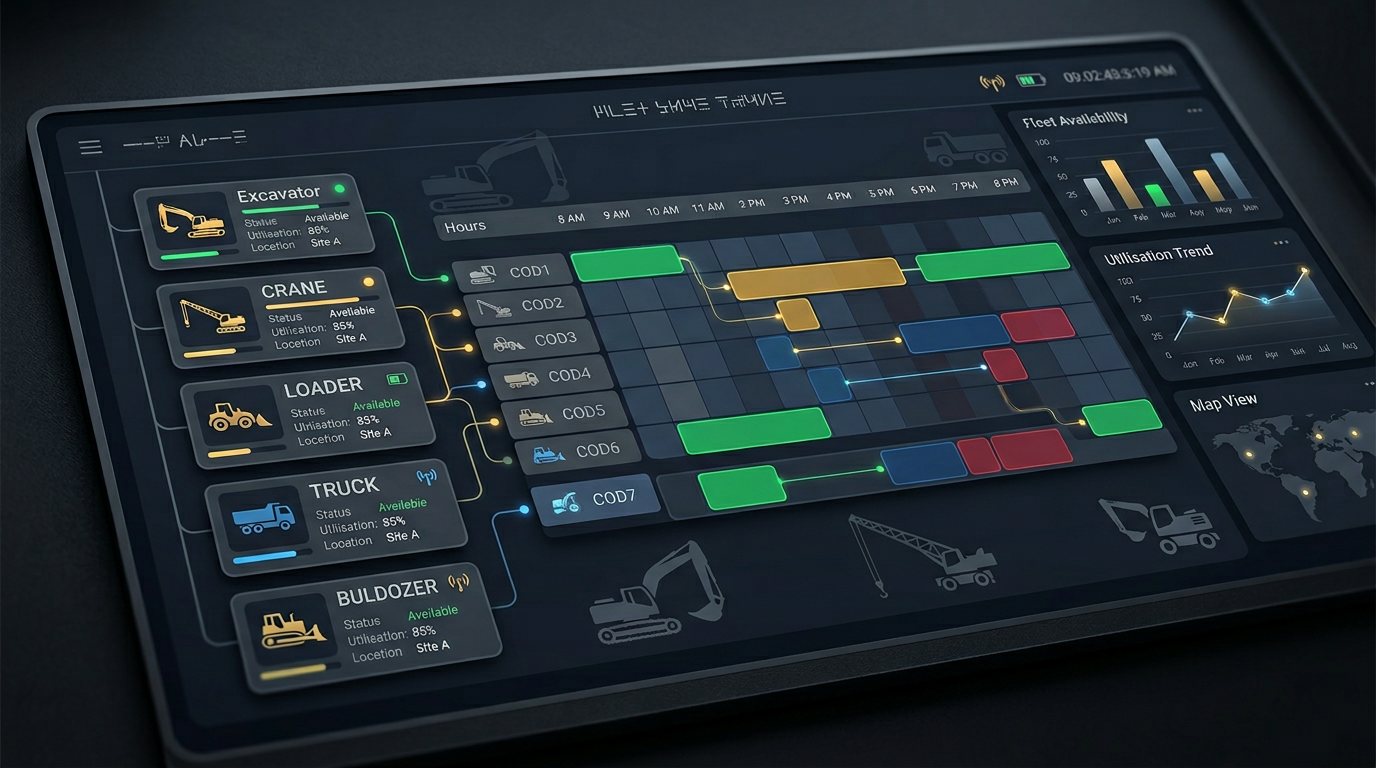
Why static availability creates avoidable friction
When availability is updated manually, every customer conversation starts with uncertainty. Sales may think a machine is open while dispatch is already holding it for another job. A customer may receive an optimistic answer that later needs to be revised once the full picture becomes visible.
This is one of the most common sources of operational friction in equipment businesses. It slows down quote response times, creates internal checking loops, and makes it harder for teams to communicate confidently with customers.
Real-time availability changes that dynamic by replacing assumption with a shared operational view. It turns availability from a rough estimate into a live decision signal.
What availability should include beyond the calendar
A useful availability model goes beyond whether a machine is booked on a specific date. It needs to include maintenance windows, inspections, transport buffers, setup time, operator readiness, and internal holds. Otherwise the calendar may look clean while the operation is not actually ready to deliver.
This is especially important in heavy equipment, where the machine itself is only one part of feasibility. A crane might technically be free, but not positioned correctly, crewed correctly, or timed correctly for the next assignment.
Availability becomes more reliable when it reflects operational readiness, not just booking status.
- Maintenance and inspection windows
- Travel and setup buffers
- Operator allocation and certification dependencies
- Internal reservation or review holds
Why shared visibility improves both sales and dispatch
Sales teams move faster when they can quote from a reliable source of truth. Dispatch teams work more calmly when they are not constantly correcting assumptions made upstream. The result is not only efficiency, but a stronger operating rhythm between teams.
Shared visibility also reduces the amount of internal verification required per opportunity. Instead of calling or messaging multiple people to confirm a slot, the team starts from a common answer and escalates only when a true exception exists.
That consistency matters externally too. Customers experience clearer communication, more realistic lead times, and fewer reversals after the initial conversation.
Where availability should be visible
For most businesses, availability should appear in at least two places: inside internal operational workflows and inside the customer-facing booking journey. The internal view helps teams plan and quote. The external view helps customers understand what is realistic before a long email thread begins.
These two views do not need to expose the exact same level of detail. Customers may only need requestability and timing confidence, while internal teams need the full operational picture. What matters is that both views are driven by the same core availability logic.
When the public-facing layer and the internal system diverge, trust erodes quickly. When they remain aligned, the business can move faster with less manual intervention.
The KPIs that show availability maturity
A strong availability process shows up in measurable ways. Quote turnaround becomes faster. Fewer bookings need to be rescheduled after confirmation. Teams spend less time validating assumptions, and customers receive firmer answers earlier.
Over time, the biggest signal is operational confidence. Teams stop treating every request like a special case because the baseline information is already dependable.
In that sense, real-time availability is not only a data feature. It is a trust layer for the entire business.
- Quote response time
- Reschedule rate after confirmation
- Internal time spent checking availability
- Customer response confidence on first contact