Why scheduling breaks under pressure
Heavy equipment scheduling looks manageable on paper until several constraints collide at once. A machine is technically available, but not close enough to the site. An operator is certified, but already committed. A customer wants a shorter lead time than the team can safely promise. This is where spreadsheet-based planning starts to crack.
The problem is not simply volume. It is the number of interacting conditions that change throughout the day. A cancellation, a site delay, or a maintenance issue can cascade through the schedule and create knock-on conflicts across dispatch, operators, and customers.
Manual planning can still work for small environments, but as soon as a fleet spans multiple machines, jobs, and teams, the hidden cost becomes decision fatigue. People spend energy rebuilding the plan rather than improving it.
What better scheduling systems actually consider
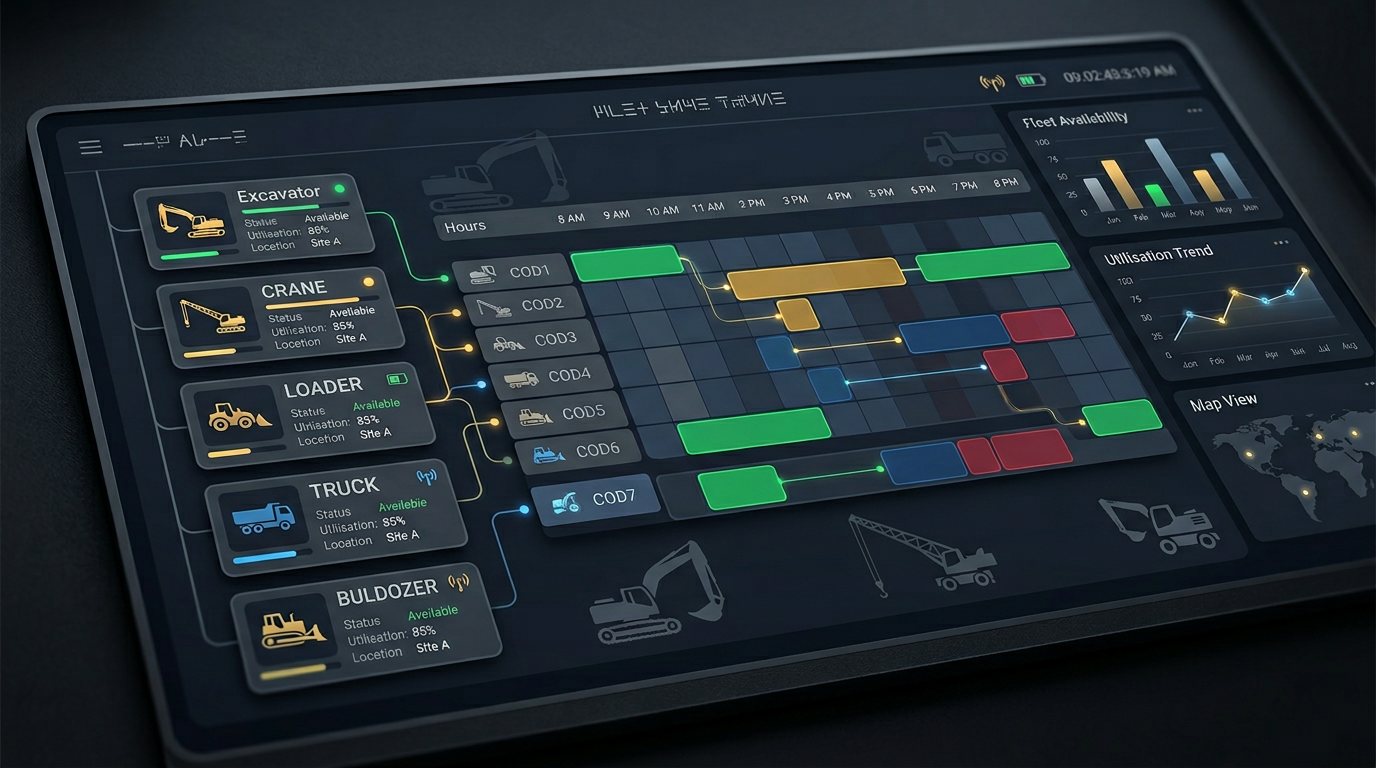
A credible scheduling system should not think only in terms of open calendar slots. It should reflect the operational shape of the business. That includes machine availability, travel time, setup windows, operator certifications, maintenance blocks, commercial priorities, and the confidence level of each booking.
The value comes from combining these signals consistently, not from using artificial intelligence as a label. If the system ignores the practical constraints of dispatch, it creates noise instead of clarity.
The best tools help teams answer real questions: Which assignment creates the least operational friction? Which option protects margin? Which change solves the customer problem without creating a bigger internal one later?
- Equipment availability and utilization windows
- Operator skills, shifts, and certifications
- Travel, setup, and turnaround time
- Booking priority and commercial urgency
Why AI should support planners, not replace them
In operations, trust matters more than novelty. A scheduling engine becomes useful when it gives dispatchers a recommendation they can understand, challenge, and adjust. It should narrow the field of possibilities, surface risks earlier, and shorten the time needed to create a workable plan.
That is especially important in crane and heavy equipment businesses, where local knowledge still matters. Dispatchers know which sites are difficult, which customers change often, and where practical constraints are not fully captured in a data field. Software should work with that expertise rather than attempting to ignore it.
The right model is collaborative intelligence. The system calculates options at machine speed; the operator applies commercial and operational judgement. That combination outperforms either pure automation or pure manual planning.
What changes when scheduling becomes proactive
Teams usually feel the difference in three places. First, the day starts with a more credible plan. Second, disruptions are easier to absorb because the system can re-evaluate alternatives quickly. Third, communication across sales, dispatch, and operations becomes clearer because everyone is working from the same operational picture.
This affects utilization directly. Idle gaps shrink when assignments are sequenced more intelligently, and unnecessary clashes decrease because constraints were considered earlier. That does not mean every schedule becomes perfect. It means the business makes fewer avoidable mistakes.
It also changes the customer experience. More realistic commitments, faster responses, and fewer last-minute corrections build trust over time. Customers often judge operational quality by predictability, not by flashy technology.
- Fewer avoidable conflicts
- Faster replanning when conditions change
- Better coordination between commercial and operational teams
How to introduce intelligent scheduling without disruption
The strongest implementations begin with transparency, not automation for its own sake. Start by mapping the constraints that already drive scheduling decisions today. Then identify the cases where better recommendations would save the most time or protect the most margin.
From there, it becomes easier to phase in. One team might start by using AI recommendations as a planning layer before final confirmation. Another might use it first for conflict detection or schedule reshuffling. Adoption works best when the system earns trust through relevance.
The long-term goal is not to make scheduling feel algorithmic. It is to make operations more resilient and easier to scale. Intelligent scheduling succeeds when it gives teams more control, not less.